Paper cards normally cost less initially. NFC cards cost more upfront and may include a subscription or renewal. Neither starting price tells you what professional introductions will cost over the next few years.
The useful comparison is not the price of one paper card against one NFC card. Compare the complete cost over a realistic usage period, including orders, unused stock, information changes and continuing digital service.
“What will each option cost over the period in which I expect to use it—and what value will remain after each introduction?”
This guide examines paper vs NFC business cards through that financial lens. For a broader assessment of formats and interactions, see our guide to choosing between paper, QR and NFC visiting cards.
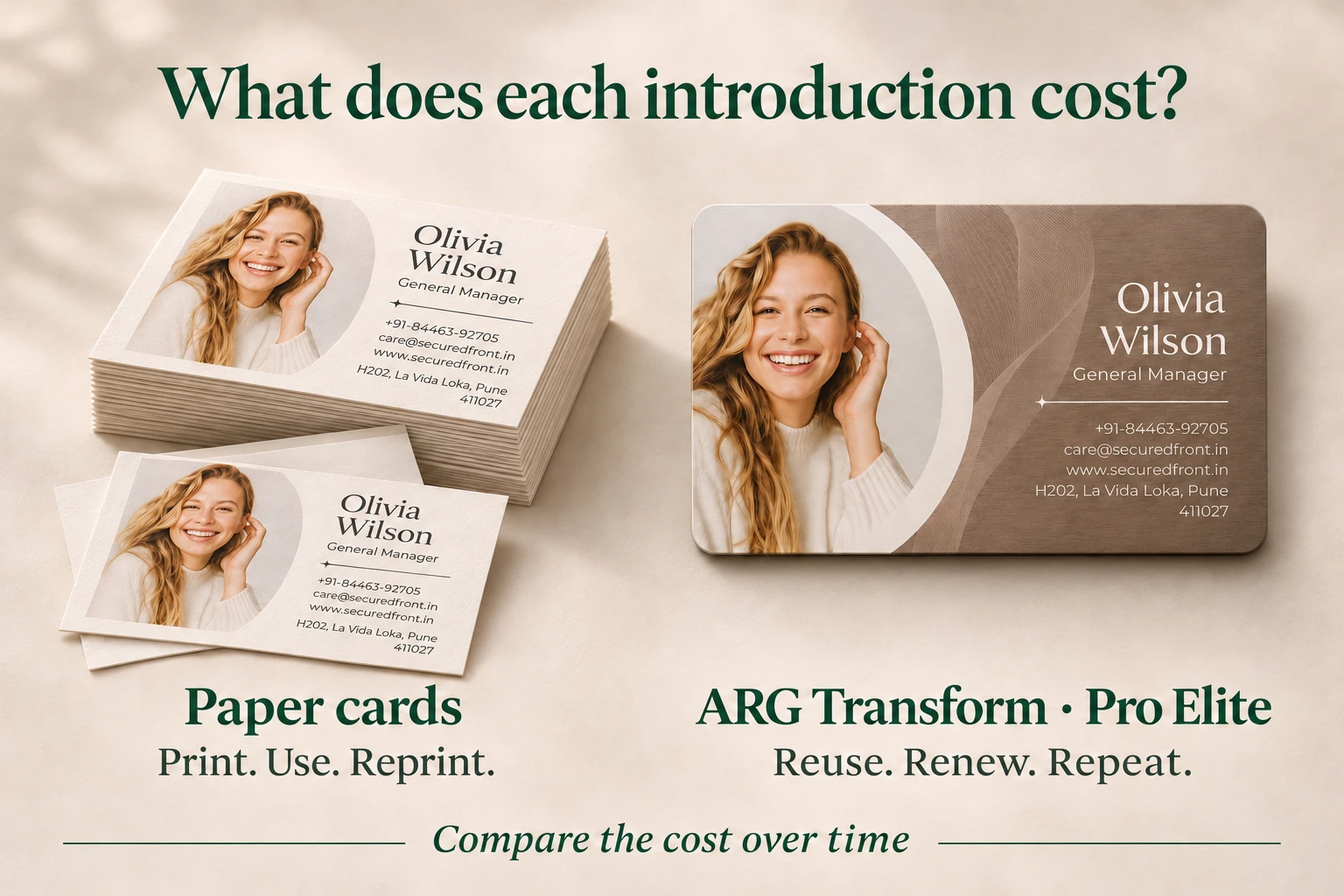
Paper and NFC cards work differently
A paper card is handed over and consumed: the next recipient needs another card. An NFC card normally stays with its owner and is reused. Its purchase supports repeated introductions rather than a fixed number of handouts.
NFC and a printed QR code may open the same digital profile. The recipient must choose to open the profile and select Save Contact. Tapping does not automatically save contact information; scanning a profile QR code does not automatically save it either. Budget for the exchange people actually complete, rather than assuming every tap becomes a saved contact.
What contributes to the cost of paper business cards?
Paper business card printing cost starts with design and artwork correction, then depends on paper type and GSM, single- or double-sided printing and quantity. Lamination, rounded corners and special finishes can add to the bill. Include taxes, packaging and delivery when comparing quotations.
Urgent printing and later reprints can change an apparently inexpensive purchase. Damaged cards and unused cards still cost money, even though they never support an introduction. A larger order may reduce the unit price while increasing the amount tied up in stock.
“The lowest cost per card is not necessarily the lowest cost per useful card.”
Our visiting-card printing checklist explains the production choices to confirm before placing an order. Compare complete, equivalent specifications rather than a basic print price against a fully finished quotation.
What contributes to the cost of an NFC business card?
NFC business card cost has two separate components: the physical card and the digital service it opens. The initial price may cover the card, custom printing or design, profile setup and delivery. A subscription or renewal may fund continuing access, editing or additional capabilities.
Check replacement charges and what is included for employee profiles, document or media hosting, analytics, contact collection, team management and card reassignment. These may be included, limited or charged separately, depending on the provider and plan.
A “one-time NFC card” does not automatically mean a lifetime digital profile. Physical ownership, profile validity and editing rights are different terms. Compare what shapes NFC business card prices and what to check with NFC cards without subscriptions before treating the NFC card price as your final expenditure.
Compare costs over the same period
Use one, two or three years for both options. Choose a period that reflects your role, likely information changes and networking activity. Record the same assumptions for taxes, delivery and the number of people you expect to meet.
Paper: Printing cost per order × number of orders, plus design, delivery, urgent printing and unused stock.
Count each cash expense once. If delivery is included in an order, do not add it again. Likewise, unused stock is already paid for within printing expenditure: record its value as a wasted portion of that total, not a second cash charge. It changes your useful-card denominator.
NFC: Initial card and setup cost + renewals + expected replacement cost.
Include any separately billed delivery, tax or required add-ons in the initial total. For expected replacement cost, use a realistic allowance based on handling and the quoted replacement price. Test a no-replacement scenario and a replacement scenario if the likelihood is uncertain.
Illustrative paper-card calculation
This is an illustrative calculation, not a market quotation. Suppose 500 paper cards cost ₹1,000 including delivery. The apparent cost is ₹1,000 ÷ 500 = ₹2 per card.
Only 200 are used before the office address changes. The effective cost of that first batch is ₹1,000 ÷ 200 = ₹5 per useful card. The remaining 300 cards account for ₹600 of the original expenditure; that amount is already included in the ₹1,000 paid.
A replacement order costs ₹1,200. Total expenditure becomes ₹2,200. The final cost per useful introduction depends on how many cards from the replacement batch are actually used. Buying the second batch does not itself create more introductions.
Illustrative NFC-card calculation
Suppose an NFC card and digital service cost ₹1,600 for the first year. These figures are examples, not market quotations or ARG Transform prices.
- At 100 introductions: ₹1,600 ÷ 100 = ₹16 per introduction.
- At 300 introductions: ₹1,600 ÷ 300 = approximately ₹5.33 per introduction.
For the second year, assume an illustrative digital-service renewal of approximately ₹800—half the first-year card-and-service cost—while continuing to use the same physical card. This is an example, not a quoted renewal price; actual charges depend on the provider and plan.
- At 100 introductions in the second year: ₹800 ÷ 100 = ₹8 per introduction for that year.
- At 300 introductions in the second year: ₹800 ÷ 300 = approximately ₹2.67 per introduction for that year.
Total expenditure over two years would be ₹1,600 + ₹800 = ₹2,400. At 100 introductions each year, that is ₹2,400 ÷ 200 = ₹12 per introduction across both years. At 300 introductions each year, it is ₹2,400 ÷ 600 = ₹4 per introduction.
These calculations assume no replacement or additional charges. Add any replacement cost before calculating your own totals, and divide expenditure by introductions across the same period. An introduction is not a guaranteed contact save, enquiry or sale.
Usage frequency can change the result
Paper may remain economical for infrequent introductions, basic details, small print quantities and stable information. It also suits situations where you need to leave a physical reminder and do not need a digital profile. A low annual printing bill can be difficult to improve upon financially.
NFC may become economical with regular meetings or networking, repeated use and changing information. Sharing portfolios, brochures, reviews or videos may make a maintained profile useful. Accessing the same profile through NFC, QR and a link can extend its use beyond in-person meetings while reducing repeated print orders.
Estimate activity from your own calendar. A professional meeting ten new people each month has a different cost pattern from someone attending several busy exhibitions. Avoid assuming that every event attendee will become a useful introduction.
Information changes and reprint costs
A new phone number, email, website, address or designation can trigger paper card reprinting. A change of company, logo or brand identity may require fresh artwork as well. Products and services can change even when your basic contact details remain stable.
An editable digital profile may reduce physical reprints, depending on the provider and plan. However, details printed on an NFC card remain physical: an outdated printed phone number or logo may still justify replacement.
Check the QR destination too. A code pointing to a permanent, editable profile may keep working after content changes. A code pointing directly to an abandoned website or file may not. Confirm who controls the destination and whether redirecting it requires payment.
Unused paper stock
Bulk ordering can leave stock unused after job or designation changes, rebranding, office relocation or employee departures. Low usage, outdated information and physical deterioration can also turn an inexpensive batch into an expensive supply of unusable cards.
Before reordering, count usable stock and review how many cards you actually handed out. Smaller batches can cost more per printed card yet reduce the money lost when details change. Store cards away from moisture, dirt and bending to protect the stock you intend to use.
This is a financial stock-management question. Unused quantities alone do not establish environmental savings; those would need reliable project-specific data.
NFC replacement risks
A reusable business card can be lost, scratched or bent. Heat or pressure damage may affect the card or its antenna. Because one card supports many meetings, losing it can interrupt your normal sharing routine until a replacement arrives.
Employee departure and outdated information printed on the card can also create replacement needs. A platform may allow reassignment of the profile while the physical card still carries the former employee’s name.
Check replacement prices, warranty coverage, reassignment and profile-transfer terms. Ask whether an existing profile and QR destination can continue with a replacement card. Keep a shareable profile link or QR fallback available while waiting.
Subscription cost and useful capabilities
A paid digital service may include an editable profile, portfolio or brochure, reviews and video, Save Contact, voluntary contact collection, paper-card scanning, meeting context, analytics, team administration and support. Availability and limits vary by provider and plan.
Digital business card renewal is worthwhile only when you benefit from those capabilities. Someone who regularly updates project work may value editing; someone sharing stable basic details may not need the same service. Review actual use before renewing rather than paying indefinitely for a feature list.
Our guide to free versus paid digital business cards offers a way to assess that decision. Include time spent maintaining content in your practical assessment, even if you keep it separate from cash expenditure.
Cost per useful introduction
Distributing a paper card does not guarantee it will be read or saved. Similarly, an NFC tap does not guarantee that the recipient will save the contact or follow up. Neither a print count nor a tap count measures the whole outcome.
Evaluate whether the exchange helps the recipient understand the professional, access relevant information and take the next step. Define a useful introduction consistently—for example, a relevant conversation followed by an agreed way to reconnect—then divide total expenditure by that count.
Cost per business introduction becomes more informative when both formats use the same definition. Keep raw handouts, profile visits and meaningful conversations separate, and avoid treating a low cost per tap as proof of better commercial results.
Where paper continues to offer value
Paper provides a tangible reminder with no phone interaction required at the meeting. The recipient can pass the card to someone else, add handwritten notes or keep it as a physical takeaway.
Formal or traditional expectations may also make a paper exchange appropriate. For some recipients, a card left on a desk is more convenient than opening a profile during a busy conversation. These practical benefits deserve a place in the budget even when another format offers more content.
Where NFC can offer additional value
NFC can open a digital profile containing contact details, company information, a portfolio, brochure, product catalogue, reviews, video, website, location and an appointment or enquiry option. Not every provider includes every feature, and some capabilities may require a particular plan.
The financial value depends on whether that content helps your actual introductions. A relevant brochure may reduce the need for a separate follow-up attachment; an unused video adds little. Explore what digital visiting cards can share beyond a number when deciding what is worth maintaining.
A combined strategy
A professional can retain one reusable NFC card for regular meetings and a smaller quantity of paper cards for selected recipients. A QR code on paper cards can lead to the same digital profile available through NFC and a shareable link.
For example, someone planning a 1,000-card print run might instead order 100 or 200 paper cards while retaining an NFC card. This is an example, not a universal recommendation. Add the smaller print order, NFC purchase, renewal and replacement allowance before deciding whether the combination saves money.
A combined budget works best when each format has a clear role. Keep enough paper for genuine physical-takeaway needs and reassess quantities after observing usage.
Comparison of ongoing cost factors
On smaller screens, scroll horizontally to read all three columns. You can focus the table area and use the arrow keys.
| Cost factor | Paper business cards | NFC business card |
|---|---|---|
| Initial purchase | Usually lower | Usually higher |
| Repeated use | Requires another card | Same card can normally be reused |
| Information changes | Usually requires reprinting | Profile may be updated digitally |
| Annual service fee | Usually none | May apply |
| Loss or damage | Low cost per individual card | Replacement may cost more |
| Bulk-order waste | Possible | Not usually applicable |
| Physical takeaway | Included with every exchange | Card normally remains with the owner |
| Rich digital content | Requires a QR code or separate link | Can open a digital profile |
| Team changes | May require new printing | May support reassignment, depending on the plan |
| Long-term cost | Depends on consumption and reprints | Depends on usage, renewal and replacement |
Questions before calculating the cost
For a paper-card purchase
- What is the complete price, including artwork, tax, packaging and delivery?
- What quantity will I realistically use before details change?
- How stable are my information and branding?
- Would smaller print runs reduce unused stock despite a higher unit price?
- Can the printer maintain reproduction consistency on later orders?
- Who controls the QR destination, and can it remain usable?
- What is the reprint policy for errors, corrections and urgent orders?
For an NFC purchase
- What does the initial price include, and what is the renewal charge?
- How long is the profile valid, and what happens after non-renewal?
- Which editing rights are included, and for how long?
- What will replacement cost, including delivery and activation?
- Can the card or profile be reassigned when employees change?
- Is there a working QR fallback to the same profile?
- Can I export my data and contacts if I leave?
- Which paid features will I realistically use?
How ARG Transform fits into the comparison
ARG Transform connects a professional digital profile with a reusable NFC card, QR code and shareable link. A recipient can view contact information and supporting material such as a portfolio, brochure, reviews or introductory video without installing an app.
The recipient must choose to open the profile and select Save Contact. Opening the profile does not automatically save your details or share the visitor’s information with you.
ARG Transform also supports the other side of the introduction. You can scan a prospect’s paper visiting card to capture its details, or the prospect can voluntarily provide their information through the Share Back option. This can help retain the person’s identity and the context required for meaningful follow-up.
Compare the edition’s current price, profile terms and included capabilities with your expected usage before choosing.
Choose the cost pattern that fits your introductions
Paper may cost less for occasional introductions and stable information. NFC may cost less per use for frequent networking and changing information. A combined approach may provide the best balance of a physical takeaway and a reusable route to current information.
There is no universal break-even point. Your print quantities, unused stock, renewal terms, replacement needs and useful introductions determine the result.
Do not compare one paper card with one NFC card. Compare the complete cost of supporting your professional introductions over time.